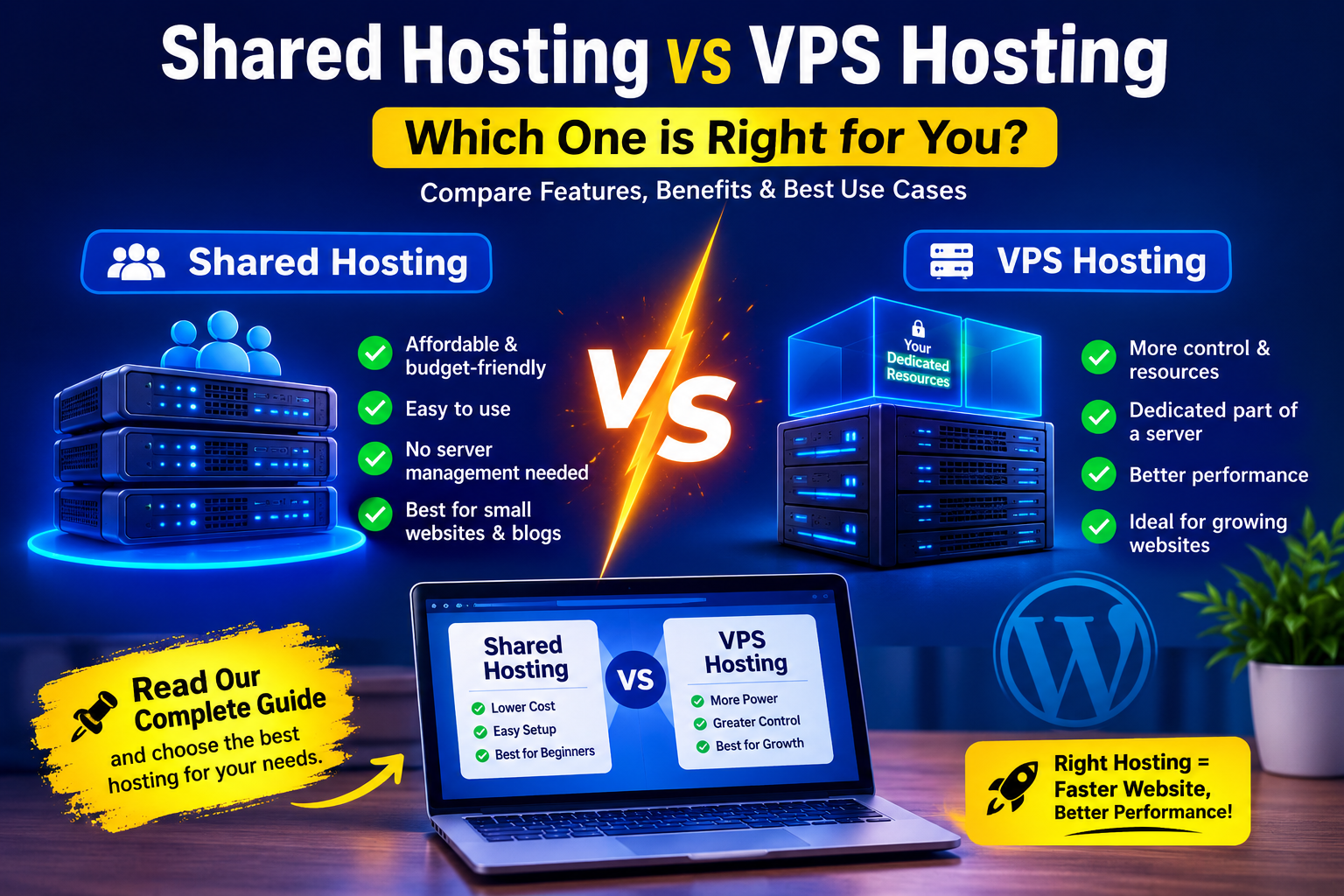
Choosing a hosting plan is one of the first real decisions you’ll make when launching or scaling a website and it’s a decision that quietly affects everything from load times to how well your site holds up during a traffic spike. Two of the most common options you’ll run into are shared hosting and VPS hosting, and while both get your site online, they work in fundamentally different ways. Understanding those differences upfront can save you from outgrowing your plan too soon, or overpaying for resources you don’t actually need yet.
This guide breaks down exactly how shared and VPS hosting differ, and helps you figure out which one actually fits your website.
What Is Shared Hosting?
Shared hosting is a type of hosting plan which can house thousands of websites on a single server, and it’s known to be the most affordable web hosting option on the market.You get your own unit, but you share the building’s common resources with your neighbors in hosting terms, those common resources are the server’s processing power, memory, storage, and bandwidth.
Your website lives on a server that also hosts many others, all sharing the same pool of system resources like CPU, RAM and storage. Importantly, sharing a server doesn’t mean sharing your data on a properly configured shared server, other customers can’t see your files, and you can’t see theirs.You’re only sharing the physical hardware underneath, not your actual website content or data.
What Is VPS Hosting?
VPS hosting divides a physical server into independent, virtualized environments, each with dedicated resources.A VPS splits one physical server into isolated virtual servers, each with resources reserved for one customer so instead of competing with other websites for CPU and RAM, you get a guaranteed slice that’s yours alone.
Each VPS operates like its own server, giving you full root access, greater control over the software stack, and more predictable performance as your website grows. If you’ve explored VPS hosting plans before, you’ve likely seen this control and isolation highlighted as the core advantage over shared plans.
Key Differences Between Shared Hosting and VPS Hosting
Resources and Performance
With VPS hosting, you’ll have access to a higher number of resources for your own private use compared to shared hosting, allowing greater flexibility to scale your website.A VPS gives you more consistent performance, stronger isolation, and more control than a shared plan, since your resources aren’t affected by traffic spikes on other accounts sharing the same physical server.
Control and Customization
This is one of the sharpest divides between the two options.With a shared hosting plan, the hosting provider manages the operating system, server software, and configuration users can manage their website through a control panel and use tools like SSH and cron jobs, but can’t modify server-level settings, choose a different operating system, or install software requiring root access.
A VPS includes full root access, allowing users to configure the server according to their needs choosing the operating system, installing and configuring web servers, databases, and programming environments, and deploying software that isn’t available on shared hosting plans.A VPS also supports technologies such as Docker and Node.js, making it suitable for hosting custom applications, development environments, and APIs.
Security
VPS servers are isolated, which contributes to their security even if your VPS has vulnerabilities, it’s contained in a private virtual environment with no neighbors to exploit them. By contrast, clients on shared hosting are more vulnerable, since they share disk space with multiple neighbors, and if one website on the server has a security lapse, it can impact other sites too.
Reliability and Uptime
Shared hosting is more prone to downtime due to shared resources if there’s a server overload from multiple clients competing for large amounts of resources, the entire server might fail, causing an outage.VPS environments avoid this risk almost entirely, since your resources are reserved and unaffected by what’s happening on neighboring accounts.
Cost
Shared hosting remains the more budget-friendly entry point, which is exactly why it’s such a popular starting choice for new websites. A shared hosting plan is more than adequate to keep a modest website running smoothly and efficiently for a small blog or brochure site, while VPS plans command a higher price in exchange for dedicated resources and greater control.
Which One Should You Choose?
Choose Shared Hosting If:
- You’re launching a new website, blog, or small business site
- You have limited technical experience and want a fully managed environment
- You’re looking for an easy, low-cost way to get online
- Your traffic is modest and relatively predictable
- A one-click install for platforms like WordPress is all the setup you need
Choose VPS Hosting If:
- Your website is growing and starting to outpace shared hosting limits
- You run a high-traffic website that requires greater control, enhanced security and scalability
- You need to install custom software, specific programming environments, or run applications like Docker
- You’re running an e-commerce store or any site handling sensitive customer data
- You experience seasonal traffic spikes and need resources that won’t be affected by other accounts
Signs You’ve Outgrown Shared Hosting
A few clear signals suggest it might be time to move up to VPS:
- Your site slows down during traffic spikes, even when your own content hasn’t changed
- You need root-level access to install specific software or configure the server environment
- You’re running a growing e-commerce store with an expanding product catalog and increasing transaction volume
- Security has become a bigger priority, particularly if you handle customer payment or personal data
- You’ve hit resource limits on your current shared plan and upgrading tiers no longer solves the problem
Can You Scale from Shared to VPS Later?
Yes and this is actually one of the smartest ways to approach hosting for a new website. For many websites, shared hosting provides enough capacity for years of growth, so there’s rarely a need to over-invest in VPS resources before you actually need them. Starting with shared hosting and migrating to a VPS hosting plan once your site’s traffic and technical requirements genuinely justify the upgrade is a practical, cost-effective growth path most businesses follow.
What About Managed VPS Hosting?
If the idea of managing server-level configuration feels intimidating, managed VPS hosting bridges the gap between shared hosting’s simplicity and unmanaged VPS’s full control. Managed VPS plans include provider-managed services such as server maintenance, operating system updates, security patches and monitoring, giving you dedicated resources and better performance without having to handle every technical detail yourself.
Beyond Shared and VPS: When You Might Need More
For businesses running your own hosting business or managing multiple client websites, reseller hosting offers another path, letting you resell hosting resources under your own brand. And for websites with the highest traffic demands or the strictest performance and compliance requirements, dedicated servers provide an entire physical server exclusively for your use — the next step up once even VPS resources aren’t enough.
Making the Right Choice for Your Website
There’s no universally “correct” answer between shared and VPS hosting the right choice depends entirely on your website’s current size, technical requirements, and growth trajectory. Starting realistically, rather than over-provisioning from day one, tends to serve most website owners well, with room to scale up as genuine demand justifies the move.
Getting Started
Globalink Web Solutions offers both SSD-powered shared hosting and flexible VPS hosting plans, so you can start where your website actually needs to be today and scale up smoothly as it grows — all backed by 24/7 support and a 99.9% uptime SLA. Not sure which plan fits your project? Contact our team for guidance, or explore domain registration if you’re starting from scratch. You can also learn more about our company or check out our blog for more hosting guides.
Final Thoughts
Shared hosting and VPS hosting both have their place — one prioritizes simplicity and affordability, the other prioritizes control and performance. Understanding what your website actually needs today, and how quickly it’s likely to grow, is the clearest path to choosing the plan that will serve you well without over- or under-investing in your hosting infrastructure.